

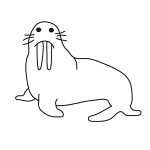
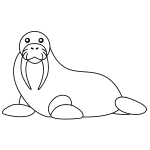
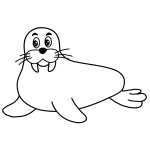
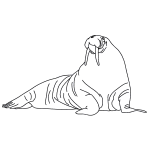
Step 1: Let's draw a walrus! Starting with the back, trace a line, not straight across but going down, as though it were the slope of a mountain. Here's a trick: curb the line in just a little bit once you get to the bottom.

Step 2: At the top of the walrus' back, add an upside down letter U for the head.

Step 3: For the face, trace a frown and then add two teeth. Here's another tip: a walrus' teeth look like large icicles!

Step 4: Next, trace three lines on either side of the face for whiskers, and two medium-sized dots for eyes.

Step 5: At the base of the back, draw the fins so that they are flat and look like petals. Make the outside flipper a little smaller than the one on the inside.

Step 6: Trace a line across the bottom of the body for the belly. Be careful not to make it a straight line; walrus' are quite heavy; you can give yours a big belly!

Step 7: Last, draw the front fins like you did the back ones, making the outside flipper a little smaller than the inside. There's your walrus! Did you know, adult walruses can weigh between 2,000 to 3,000 pounds and grow as tall as 12 feet!

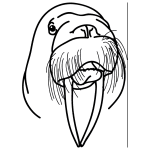
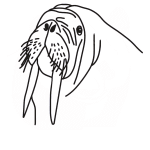

Interesting Facts about Walruses
Walruses are the only living members of the Odobenidae family; the others are now extinct. The walrus got its name from the Latin phrase that translates to, “tooth-walking sea cow.” There are three types of walruses, the Pacific walrus, the Atlantic walrus, and the Laptev walrus.
Did you know?
- Male and female walruses have tusks, but males’ tusks are longer.
- Walruses mainly feed on seafood such as crabs, sea cucumbers, snails, mollusks, octopus, fish, and seals.
- Full-grown walruses can weigh between 2,000 and 3,000 pounds, and they could grow to be as tall as 12 feet.
- Walruses make all kinds of sounds from roars, snores, and snorts, to a noise that sounds like the ringing of church bells.
- Walruses can swim underwater for up to 30 minutes.
- Walruses can eat about 120 pounds of food a day.
Pacific walruses live in waters from the coast of Alaska to northern coast of Siberia. Atlantic walruses span across the Canadian Arctic, Greenland, and the western part of Russia. Laptev walruses live near the Laptev Sea, the eastern part of the Kara Sea, and the western part of the East Siberian Sea.
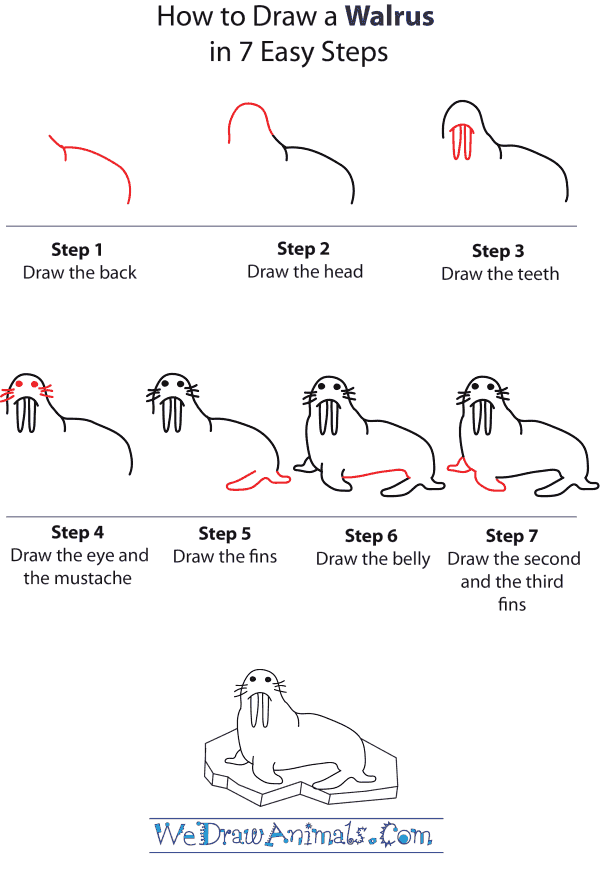
How To Draw A Walrus – Step-by-Step Tutorial