

Step 1: Start the snail by drawing the shell. It kind of looks like a fat carrot on its side. The left side has round and curved lines. The left side comes to a gradual point.

Step 2: From the left top corner of the shell draw a short line on an angle up to the left. There is another line at the same angle starting at the bottom of the shell. Make a triangle at the very tip of the longer line.

Step 3: At the end of the top body line draw a long triangular eye. There is a small circle at the very tip. Make another long triangular eye the exact same size at the tip of the other body line.

Step 4: Under the bottom of the snail shell draw the tail. It looks like a sideways question mark

Step 5: Add the shell markings. There are many long lines that run the length of the shell. There are 5 short lines that go across the body.
Interesting Facts about the Giant African Snail (Achatina fulica):
The Giant African Snail can grow as large as a human hand, 20 centimeters or more in length, with a shell about 7 centimeters in height. The Great African Snail’s shell is cone-shaped, mostly brown in color, and has a banded color pattern, and spirals upwards. It is native to East Africa, but has been introduced worldwide via the pet trade and also by accident.
Did you know?
- The Giant African Snail is born with both male and female sex organs, making it what scientists call a “simultaneous hermaphrodite”.
- These snails can lay five to six clutches of eggs a year; each clutch contains up to two hundred eggs.
- In times of extreme drought, the African Giant Snail can seal itself up in its shell for up to three years; this way it does not lose any moisture from its body and can still survive.
- The African Giant Snail is an important food source in some areas, but should not be eaten raw as it can cause meningitis.
- This species of snail is mainly active at night; during the day it buries underground.
The Giant African Snail is one of the world’s most invasive species. It can out-compete native snails once introduced to an area. In addition, human and plant diseases can both be carried by the Giant African Snail, making it a serious pest. At this time, there are no known threats to this species.
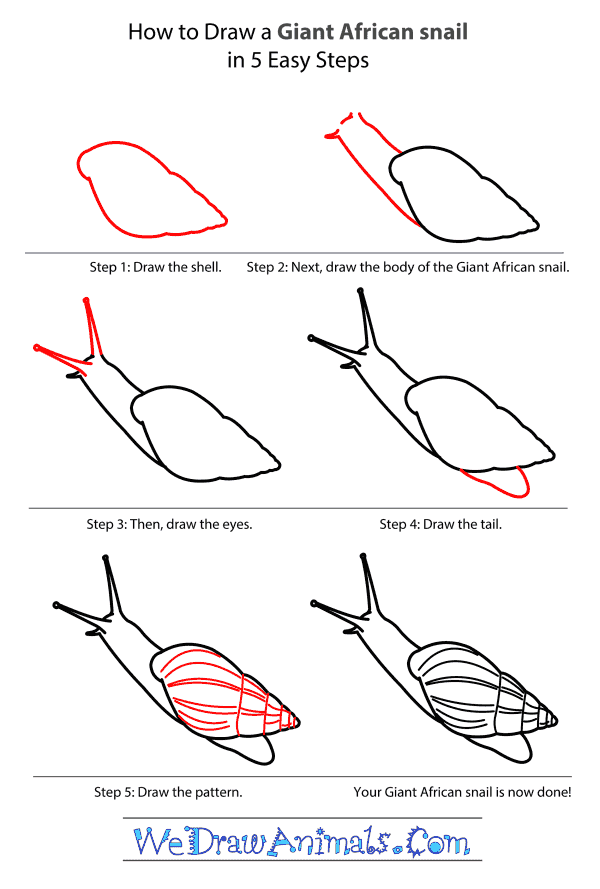
How to Draw a Giant African Snail – Step-by-Step Tutorial